
Urban waste generation in European capitals continues to rise as population density and consumption patterns increase, placing pressure on municipal systems and environmental targets. Cities are now expected to manage waste streams in ways that reduce landfill dependency while increasing recycling efficiency and regulatory compliance.
Vienna has developed a structured system that connects environmental governance with practical service delivery, where both public institutions and private operators play a role in maintaining order. Services such as Räumung Wien reflect how clearance operations are integrated into broader compliance-based waste handling, particularly when residential or commercial properties require regulated disposal support. This shared responsibility model reflects guidance from the European Environment Agency, which highlights that urban waste performance improves when municipalities collaborate with licensed private contractors under strict regulatory oversight.
Within this framework, waste management is no longer a purely municipal function. It is a coordinated system where legislation, enforcement, and operational logistics intersect, ensuring that environmental objectives are met at ground level.
Municipal Waste Systems and Legal Frameworks in Vienna
Vienna’s waste governance is largely shaped by national Austrian waste laws and EU directives, particularly the EU Waste Framework Directive (2008/98/EC), which emphasizes waste hierarchy principles such as prevention, reuse, and recycling. Municipal departments, including Vienna’s MA 48 (Waste Management, Street Cleaning, and Vehicle Fleet), oversee collection systems and enforce compliance across residential and commercial zones.
Households are required to separate waste into categories such as paper, organic material, plastics, metals, and residual waste. Improper sorting can lead to fines or corrective enforcement measures, especially in shared housing complexes where contamination rates can affect entire collection batches.
Illegal dumping remains a concern in many urban areas. According to Eurostat environmental monitoring data, improper disposal in dense cities can significantly increase municipal cleanup costs and reduce recycling efficiency. Vienna addresses this through surveillance, reporting mechanisms, and strict penalties for non-compliance.
Role of Private Clearance Operators in Policy Execution
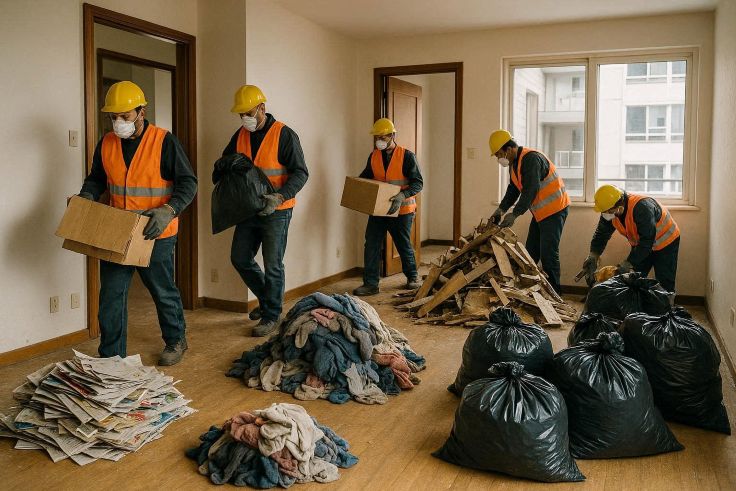
Private clearance operators act as operational extensions of municipal systems, particularly when waste scenarios exceed standard collection processes. These include estate clearances, office relocations, hoarding situations, and large-scale property cleanouts that require structured sorting and transport.
In such cases, licensed contractors ensure that materials are handled according to regulatory standards, separating recyclable components from hazardous or residual waste. This helps maintain the integrity of Vienna’s waste separation system while reducing the burden on public infrastructure.
Experts in urban logistics note that private operators improve system responsiveness, particularly during high-demand periods or complex clearance scenarios. Their role ensures that municipal services remain focused on routine collection and infrastructure management, while specialized cases are handled with technical precision.
Efficiency vs Regulation: Policy Challenges
Despite Vienna’s strong regulatory framework, balancing operational flexibility with environmental standards remains a continuous challenge. Clearance services must adapt to evolving rules on waste classification, transport documentation, and recycling quotas.
Traceability is a central issue. Authorities require documentation of waste streams to ensure materials are properly processed and not diverted into illegal disposal channels. This aligns with recommendations from the Organisation for Economic Co-operation and Development (OECD), which emphasizes transparent tracking systems as essential for circular economy models.
However, stricter compliance requirements can sometimes slow down operational efficiency, especially for time-sensitive clearance projects. Policymakers must therefore balance administrative oversight with practical execution capacity.
Urban Responsibility and Environmental Governance
Modern waste governance in Vienna demonstrates how environmental responsibility is distributed across both public institutions and private actors. Clearance companies contribute directly to recycling targets by ensuring proper sorting at the source and reducing contamination rates in waste streams.
Data from Statistics Austria indicates that Austria consistently maintains high recycling rates compared to the EU average, largely due to its structured separation systems and strong municipal-private cooperation. This collaborative model supports national sustainability goals while reducing landfill dependency. Broader industrial sectors also reflect similar patterns of environmental alignment, particularly in mobility and energy-related fields, as seen in initiatives such as automotive sustainability and community initiatives, where private actors integrate environmental responsibility into operational systems. Such examples highlight how cross-sector participation strengthens overall sustainability outcomes.
Environmental governance in this context is not limited to regulation. It includes active participation from service providers who implement policies in practical settings, bridging the gap between legislative intent and operational reality.
Case Context: Structured Clearance in Residential Areas
Residential clearance scenarios illustrate how policy translates into real-world practice. In densely populated districts, structured removal of bulky waste, furniture, and renovation materials requires coordination between property owners, licensed contractors, and municipal guidelines.
Processes often involve pre-sorting materials, scheduling approved transport, and ensuring compliance with disposal routes designated by city authorities. This structured approach reduces environmental risks while maintaining neighborhood cleanliness and safety.
Such clearance operations demonstrate how regulated services support Vienna’s broader environmental objectives. By ensuring that disposal activities align with legal frameworks, these interventions reinforce waste hierarchy principles and reduce pressure on public collection systems.
Conclusion: Shared Responsibility Model in Modern Cities
Vienna’s waste management system highlights the importance of shared responsibility between governance structures and operational service providers. Municipal frameworks establish the rules, while private clearance operators ensure practical implementation across residential, commercial, and industrial contexts.
As urban environments continue to grow, this coordinated model becomes increasingly essential. The integration of structured waste handling, compliance-driven clearance services, and environmental oversight reflects a broader shift toward collaborative sustainability governance. In this system, efficient property clearance and regulated disposal practices form a critical link in achieving long-term environmental stability.
Ultimately, the success of urban waste policy depends on consistency between regulation and execution. Vienna’s approach demonstrates that when both sectors align, cities can move closer to circular economy goals while maintaining functional and livable urban spaces.